Showing posts with label potatoes. Show all posts

19 May 2013

Potatoes

For the past five years or so, I've planted potatoes in the spring.  Last year I ended up with too many
potatoes, so this year I only bought one 5lb bag of red potatoes.  They are my favorite and I didn't need so many this year.  We had a really warm early spring and I planted about the time I usually do - February 15th - and everything seemed fine.  Then the rains came.  I've lost count now, but we had five major downpours between late February and mid-April.  I thought my potatoes would rot, but they persevered.  It wasn't until early May that I noticed I had a problem.  It looked like I had a disease on my potatoes.  I consulted the Clemson Extension, and my best guess is that my potatoes had late blight.

So, how could I have prevented this?  I always by certified disease-free seed potatoes.  There are resistant varieties, but when buying at the feed store, there's not much choice.  Keeping the foliage dry would have helped, but with so much rain, there was nothing I could do.  I usually clean up the plant debris and don't leave that lying around to spread pests and diseases.  Another problem that could have caused this is that I have planted potatoes in this spot for a number of years and have not rotated my crops like I should have been doing.

In the future I will be planting potatoes somewhere different, but this year I did get a decent harvest, so I'm satisfied  For more information on potatoes and their problems, click here.

14 April 2013

Unlikely Garden Resources

I planned to write an update for the following article this spring, so I went to Wal-Mart and Lowe's earlier this year looking for cool-season vegetables and I never found the abundance that I did a few years ago.  With the bad economy, people had started vegetable gardens, and they were growing more than just tomatoes in the summer.  A few big box stores were capitalizing on this and sold a larger selection of vegetables.


I looked at Wal-Mart in February when I planted potatoes and onions and they didn't have any.  And while I didn't look specifically for them at Lowe's, I was in and out of there a number throughout the spring and I didn't see any.  I went back the other day and I found their display. They had a huge variety of onions, garlic, shallots, and potatoes.  It's the absolutely wrong time to plant now, but I was looking at them and wondering if I could store them until fall (or spring, in the case of potatoes) and plant them at that time.  Maybe they will be deeply discounted.  Maybe they just threw them away.  I'll have to find out.

Red potato plant in bloom
Over the past couple of years, there has been a large increase in the amount of people trying to grow their own food.  It used to be people grew tomatoes or squash in the summer, but it has expanded to include other vegetables.  Excluding traditional feed and seed sources, Lowe's started selling onion sets in the spring a couple of years ago.  Last year they had these garden packs - asparagus, strawberries, potatoes, onions, leeks and shallots in small amounts, in various combinations, for the home gardener.

I made a discovery Wednesday at Wal-Mart.  I was leaving through the garden are and noticed a display that looked like it had a few winter vegetables.  I was expecting a few veggies mixed in with flower bulbs.  I was surprised to find that it was all vegetables.  They had asparagus crowns, strawberries, garlic, two types of shallots, two types of onions, and five types of potatoes.

Feed and seed stores are usually good for a couple of varieties of a couple of vegetables, in large quantities, at reasonable prices.  The vegetables at Wal-Mart are packaged in smaller quantities for the home gardener and they are more expensive.  Most home gardener don't have the need for five pounds of one variety of potato or two pounds of onion sets.  What Wal-Mart does right is it offers more specialty vegetables.

Asparagus is a perennial, which means that it lives for more than a year.  Most people probably don't have enough room in their garden to commit to asparagus for a number of years - I know I don't.

Most people grow strawberries here and there.  They can be perennials, but some experts suggest replanting fresh plants every year.  I've never grown them, but I know Robin would like me to.  I think I have issues with plants that need a certain amount of daylight to produce fruit or flowers, etc.  I think I will try growing them before long.

Any reader of this blog knows that I have had no real success with onions.  Wal-Mart offers two varieties in small quantities.  I may continue to try growing them, but I won't devote as much space to them as I have been.  And, on second thought, I may not buy them there either - a lot of them had already sprouted and had fairly long green shoots poking out of the bags.

I tried growing garlic almost a year and half ago.  The only place you can reliably find garlic is in a catalog or the grocery store.  The catalog can get expensive when you figure in shipping, so I decided to try planting garlic from the grocery store.  I wasn't expecting great results, but I thought I would give it a shot.  I waited a little late to pull them up - they had been sitting in soil that was a little waterlogged.  I put them on a shelf in the garage to dry and forgot about them.  They're still there and I noticed that started sprouting recently.   I suppose they would be fine plants, but they would not produce very good bulbs.  Wal-Mart is selling  garlic bulbs and I'm sure it's in small amounts and affordable.  I'd rather have found them in the fall, when you're supposed to plant them.  Maybe I can buy them and keep them around until October.  We'll see.

I've never grown shallots, but I'd like to.  If Robin will use them, I'll grow them.  I just don't think we've ever eaten them around here before.  I also think it's great that Wal-Mart has potatoes.  Although I'll buy the bulk of my seed potatoes, I may buy the blue potatoes that they are selling.  I like growing a few odd things.

That's it for vegetables at Wal-Mart.  I blogged about more traditional sources for some of these here.  Go out and try to grow some of these this spring!

03 April 2012

Spring is here (and so are the pests!)

Spring has probably been my favorite gardening season - everything I plant does fairly well.  Sometimes I plant broccoli, lettuce, spinach or onions, but I always plant potatoes.  One of the reasons I like spring is that it's a little too early for the bugs to be a problem.  This year is different - to begin with, we never really had a winter.  There were two or three times where we had freezing weather for a few days, but that was it.

I hate to write more about the early heat, but...the mosquitoes have been out in force for a month now.  We are approaching the "last expected frost date" for our climate zone - this is usually when we get one last cold snap - but we have had at least one day this week that the temperature was 90 degrees.  The only positive weather this spring has been the extra rain - that is nice.

OK, back to pests.  I have a bad habit of ignoring plants after they start growing good.  Part of it is that I believe they are doing fine, but the other part is that I don't multitask very well.  Once I move on to another project, I really do forget about the other thing - in this case, the vegetable garden.  Last week before I put in some hours at the master gardener office, I was watering my potatoes when I noticed one plant didn't look quite right - see if you can tell which one.

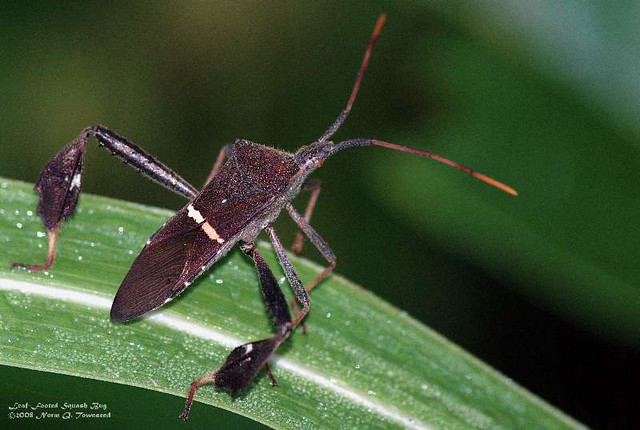
Now that I'm a Clemson Master Gardener (intern), I knew I couldn't just let it go without figuring out what the problem was.  It didn't take too long to find the culprit - I've seen these insects a lot in the last couple of years, but with the early spring, they had a chance to attack my potatoes now.  I'm talking about the leaf-footed squash bug.  It is one of the piercing insects, meaning that it pierces the leaves or shoots to feed, leaving that part of the plant in a compromised state, as you should be able to see from the photo.  Unfortunately, they are hard to manage, especially this time of year.  They have just emerged from spending winter underground (presumably), and are going to start mating.  After they have mated and laid eggs is the best time to control their population - they tend to lay them in clusters on the underside of a squash leaf.  After about ten days they will hatch into nymphs and at that time you can use an insecticide on them.

There's not a lot you can do about them when they're adults.  I tried hand picking them the other day, but it was pointless.  I decided to unleash my secret weapons on them - chickens - and hope there wasn't much collateral damage in the process.  I know I fenced the garden off from them, but maybe it would be better if they had free reign of the vegetable patch - yeah, I'm not sure about that.  I didn't see any problems when I came home after letting them into the garden, but I couldn't tell if they had eaten any bugs either.  I'll let them have at it a few more times and we'll see.

Postscript - apparently, I wrote about this topic before for the master gardener class and posted it here.

08 March 2012

Garden Update

I just thought I would mention a few things that I'm experimenting with right now.  I expect to write posts on them later, but after the final results are in.

I suggested to a friend, since she doesn't have much of a yard, that she should try growing potatoes in bags.  I wasn't sure how this worked until I read a little about it on the internet.  I did a little research and make some recommendations, but there's really nothing like trying it for yourself.  So, after watching a couple of videos, here and here, this is what I did:

I took a $2 bag of compost from Charleston County.
I emptied it to about 1/4 to 1/3 full, and rolled the sides down
Stabbed it several times - enough for drainage, but not enough to fall apart.
Planted one potato per bag, a couple inches below the surface.
Watered well.

As the plant grows, I'll roll the bag up, filling with more compost.  When it's ready to harvest, all I have to do is cut the bag open.  I'll let you know in late May/early June how it turned out.

I was at a neighbor's house last weekend.  He's really into permaculture - something I know very little about.  One of his garden projects is creating multiple mandala gardens - in this case, they are circular gardens with a "key" path to access the center of the circle.  It could look fairly formal when it's completed.  I've gone through so many ideas about the landscaping in our front yard, that I really couldn't decide on one thing.  After seeing his yard, I returned to a more formal design, but incorporating vegetables into the beds, as well as annuals and perennials.  I've been playing around in the yard with a couple of different designs and I hope to settle on one by the weekend and start planting.

I can't end this post without mentioning the chickens, right?  The past few weeks have seen a little rooster drama - our (unexpected) Rhode Island Red rooster, Maximus, figured out that he was 2-3 times the size of our little silkie rooster, who was the alpha male.  Once Maximus became alpha, there was no peace.  He would try to attack Silkie when he could.  I started letting Silkie out of the coop first thing in the morning, before he could get attacked.  Once all the birds were out in the yard, there was less drama - Maximus chased, but Silkie was able to run away.  We decided to get rid of Maximus, for the good of the flock.  It took a little effort on craigslist, but we had someone come get him the other day.

I''ve got a number of posts in the pipeline - I just have to finish writing them.  In the meantime, I hope these suffice.  Stay tuned.

Plantin' Time

Every year I buy some version of the Farmer's Almanac intending to incorporate it into my gardening practices, and I never do.  I looked at it this past week and, if you believe in it, it was good that I did.  I've been trying to get out in the garden and plant potatoes, but things have kept me from it.  I checked the almanac and its recommendations were:

February 16-17 - Neither plant nor sow on these barren days.

I'm glad I looked!  I know it seems a little superstitious, but it can't hurt to choose one day over another, right.  One of the Farmers' Almanacs is online - I know of two competing versions - I was looking for another one to see if they have conflicting information, but I couldn't find the same information from the other one online.  I would like to buy the other one and compare.  The Almanac did tell me that this weekend would be good to plant potatoes:

February 18-20 - Any root crops that can be planted now will do well.

That's good because, being President's Day weekend, I had plans to do a lot of work in the yard, including planting spring vegetables.  I had to finish fencing off the garden from the chickens, fertilizing and actually plant.  I have a lot of chicken wire left over from building the coop.  My design for the fence included securing 2x4s in the holes of the concrete blocks that make up the raised beds.  I'll attach chicken wire to the posts.  I'm trying to use materials I already have - I have some wood in the garage, but I was able find several more good pieces in people's trash.  I couldn't decide how permanent I wanted to make this - I wanted it to be sturdy, but maybe not forever.  I dug out the concrete block holes as deep as I could manage and, after putting the 2x4s in the holes and leveling them, I added pea gravel that I had lying around.  After attaching the chicken wire, it's not that bad.  You can't lean on the posts, but it'll certainly keep the chickens out.  If I have a problem with it, I can always go back later and add concrete to the holes.  As I started preparing to plant today, I realized that making it chicken-proof, it also made it harder for me in the process.  One of these days we might fence off an area just for the chickens, but that day hasn't come yet.

I've never planted sugar snap peas before.  I figured out you're supposed to plant them in the spring, the same time you plant potatoes, onions, etc.  I had only heard of the kind that trellis and was looking forward to growing something on mine.  I bought some along with potatoes from Red Top Feed and I looked up the variety, "Sugar Ann", when I got home.  I discovered they were a bush-type plant and didn't need trellising.  That was ok - I still had to get more potatoes from the feed store, so I would get a different variety later.  When I went back and asked about a "running" pea, they had to call their other store, but afterward, they said the running pea was the "Sugar Snaps" variety.

...it's been a few weeks since I started writing this post and everything I planted is up.   I planted the potatoes a little closer than I have in the past, hoping to get more from the same amount of space.  I also planted both kinds of peas - I just noticed today that some of the "runner" peas are starting to look for something to grab onto - like a trellis!  I'll have to remember these varieties in the future so I know.

I have a good bit of peas left over, even after giving some to a neighbor.  I'm in the middle of designing the landscaping out front to incorporate vegetables into it, so I'm thinking of planting a lot out there - until I start planting warm season crops and perennials there.  Stay tuned for updates.

12 December 2011

Countryside and Small Stock Journal

During the last couple of years, I would pick up issues of farming, chicken, gardening or otherwise "rural living" types of magazines in order to get some ideas about gardening or raising chickens or living a greener life.  One of these magazines initially struck me as odd in their articles and their advertising.  It seemed like a freaky source of information about living off the grid - solar power, composting toilets and the like.  I now think of this magazine, Countryside and Small Stock Journal, as an interesting facet of living the rural life.  Recently I've gotten some good information about raising chickens and growing potatoes in straw.

After looking for some of these articles online, I found a site that seems to have the past eighteen years of this magazine online, free.  It's something I'd like to spend a little time going through during the winter.  Maybe I can learn a little something.

09 February 2011

Planting Potatoes Again

It's that time of year again - potato planting time.  Everywhere in my list of feed and seed resources had potatoes this time.  Two of them had three kinds of potatoes - white, red and Yukon gold, and the other just had red and white.  I'm never sure how much space I want to dedicate to a single crop.  They might not be completely harvested until almost June, and I need room to plant warm season crops.

I planned to buy three kinds of potatoes, plus the purple ones from Walmart, but when I got to the feed store, they were sold out of the Yukon gold potatoes.  I bought five pounds each of the red and white, and a bag - maybe three pounds - of the purple ones.  In the past I have planted them whole, rather than cutting them into pieces, and possibly getting more from them.  Everything I read talked about fungi and treating them or letting them "heal" for a few days before planting them, so that's why I never did it before.  Since then I've talked to neighbors who do it and have no problems, so I decided to consider it this time.  As I was looking at the potatoes, I never saw one that was really fit for dividing.  Most of them had eyes on one end or the tubers were small to begin with.  The packaging for the purple ones instruct you to plant the whole spud.

I was doing some research on the purple potatoes and thought I would share what I learned about it and the other varieties.  Do you know which varieties are better baked, or mashed or made into fries or chips?  I don't, so I decided to find out.

Purple Majesty potatoes were created by crossing an All Blue with a white chipping variety.  They are high in Anthocyanin, which is an antioxidant found in blueberries.  They taste like white potatoes and are good for almost any kind of preparation, but apparently make great fries and chips - plus they retain their color after cooking.  Red potatoes have smooth, thin, red skins and white flesh.  It is usually firm and mainly used in casseroles, soups, salads or boiled, steamed and roasted.  White potatoes are good baked, boiled or roasted, and especially good for potato salad.

08 February 2011

Country Wisdom

I say "country wisdom" for lack of a better term - I know there is one, but I can't think of it.  I'm referring to that intangible knowledge that older people/country folk have that others don't - call it a "hunch".  My friend Darren, neither old nor country (but a master gardener), saw signs of a cold winter a couple of years ago.  Oaks were putting out massive quantities of acorns, squirrels were busy gathering them up.  From what I remember, he was right.

Our neighbor Mr. Hiers has a feeling that we haven't seen the last of the brutal cold this year.  I went by his house last week to see if he wanted me to by him any seed potatoes.  Over the last couple of years we have talked about gardening and he seems to get his plants in a haphazard way.  I thought I would offer to get him these same plants when I go get mine.  So, when I asked him if he wanted potatoes, he said no.  He thought we were going to get more cold weather and was going to hold off until March.  I tried to tell him there probably wouldn't be any potatoes available in March, but actually he was the one that had me second-guessing my decision to plant in mid-February.  I wasn't worried about it until I talked to him.  I'm still planning to plant potatoes this week - the weather looks fine for the next week, except for a couple of nights near freezing this weekend.  The average low for the rest of the month is 40 degrees.

I bought potatoes today - I got red and white from the feed store (they had sold out of Yukon gold) and I got some Purple Majesty potatoes from Walmart I want to try.  I'll probably be planting a bed of each potato and then growing lettuce and spinach on top of them until the weather warms up.

24 June 2010

Potatoes

If you look at my labels to the right, you will notice that onions and potatoes top the list. Part of the reason is that they are two cool season vegetables that can be grown twice a year. The photo is of the last of our potatoes I harvested this week. I planted them in mid-February and have been pulling them up for the past month. Apparently you can plant a fall crop of potatoes in mid-July for harvest in November, before it gets too cold. No one I know that grows potatoes has done that, but I think I'm going to have to try it out.
The problem with that is that feed stores only sell potatoes in February. I may call around for the heck of it, but I don't expect results. I could try planting some I bought from the store, but I feel like I might be wasting my time with those. They are usually treated so they won't sprout. I thought about planting some that I have already grown, but I'm not sure about those either. There are also problems with catalogs too - the cost of shipping whole potatoes is not worth it. I did find a catalog that sold potato eyes, and I kept it, hoping they would still sell them when it was time to plant a second crop, but I've misplaced it at the moment. It seemed really reasonable - the price was good and shipping wouldn't cost as much since it was only the eyes and not the whole potatoes. Hopefully in the next month I'll be able to locate potatoes suitable to plant for a fall harvest.

15 May 2010

Potatoes and Lettuce

I get curious about potatoes, probably because they're growing in the ground, where I can't see them - too curious, perhaps. Last year we ate most of them as new potatoes, but I'm trying to be patient this year. I dug up one small plant last weekend, because it was dying and I got a single Yukon Gold potato from it. Then I decided to dig up a potato without pulling up the whole plant - so I got two new potatoes last weekend, but I'm trying to hold out. I pulled up a plant one morning this week before work and got a large handful of them. I and going to be good and wait, but we've got enough for dinner this weekend if we want them.
Earlier this week I knew Robin was planning to cook dinner, but I was hungry when I got home from work. There was nothing I really wanted, so I went out to the garden and pulled up some lettuce and spinach and had a big salad. We did this one night not too long before that, and I told myself I should do that every day this week. Unfortunately, I didn't stick to that plan - when I dug up the last potatoes, the lettuce was in the process of bolting. Summer is definitely here!

23 April 2010

Blooming Potatoes

Last spring was the first time I had ever grown potatoes - I didn't know what to expect. I watched an empty garden, what was going on below ground. Eventually they began growing - I was so excited. After a while I started wondering when I could dig them up. I was told that when they were blooming, you could harvest "new" potatoes. I waited and waited but no blooms - I heard that sometimes they don't bloom - so I started digging. We ate a lot of new potatoes last spring, before torrential rains came and ruined the potato crop.

This year is different - I've got raised beds which means no flooding, and I've got three kinds of potatoes and my red ones are blooming. It really surprised me, since none of them bloomed last year, but those are the only ones. I don't know whether or not the others will - we'll see.

24 March 2010

Garden Update

I have a lot of gardening and landscaping plans for the spring and summer - I just haven't gotten to them yet. I realized as my seeds* were sprouting this week that I was using my only completely free raised bed as a cold frame and I needed to do something about that.

*Both varieties of squash are sprouting, Razzleberry tomatoes, a few cucumbers and maybe a pepper, coneflower and agapanthus. I've also got another tomato, another pepper, watermelon, beans and corn to get started as well.

I can't decide what to do with my pole beans. I was going to put up a trellis made from conduit and twine, but now I'm wondering if it would be easier to do a tripod/tepee in the flower beds where I plan to grow watermelon, squash, cucumbers, pumpkins. I have so many questions about that - I was going to grow cucumbers up a trellis, but they're "salad bush hybrid" - does that mean they will be less of a vine? And am I planting too much of the same family together - squash, cucumber, pumpkins, watermelon?

Anyway, I got some more compost this morning. I opted to get $2 bags from the Romney Street location rather than loading my own at the landfill. I don't need as much right now - just enough to improve the soil in the landscaped beds so I can plant veggies out there. I'm rethinking the design of the bed, now that I've included part of the front yard in my vegetable gardening plan. I've got citrus that I want to put back into a pot, daylilies that I'll eventually move somewhere else - the same goes for the lilies, irises and phlox. I've got garlic that I'll harvest this summer. After all that, maybe I'll be able to design a nice planting that lets me incorporate long term landscaping with vegetables.

Other things growing - The potatoes I planted just over three weeks ago have broken the surface and the spinach is getting to be large enough to start harvesting. Daylilies have sprouted. The water hyacinths in the pond - I had given up on them, but hadn't tossed in the compost pile - they've got new growth on them.

My list of things I want to do is growing as well. The area in the front yard where the garden is, will become a continuation of the side flower bed and curve around in front of the house. I have to edge and smother the grass and mulch. Then I have to decide what to plant and put a path through it to the side gate. I'm planning to use pieces of broken concrete to make something that looks like a stone path. I've started collecting it recently.

I'm planning to take another shot at a shade garden, my first attempt not being the best location, as it turns out. I hope under our oak tree will be good enough. It gets a little morning sun and a little more evening sun - I hope it won't be a problem. I have a 50% off coupon for a garden catalog that I was going to use to buy all the plants for the shade garden when I was ready, but the coupon expires in April and I just don't think I'll be working on it at that point - and with shipping, who knows how much I'll really save.

According to my plan, I need to build two more raised beds (maybe three). I also need to lay out beds in the back yard. There's a strip of grass about a foot wide along the driveway that I want to rip up and plant a ground cover...

More rain barrels, chickens, rain garden/bioswale. The list goes on...

04 March 2010

Spring Vegetable Gardening

Last weekend I finally got my potatoes and onions in the ground. While I was at it, I planted more lettuce and spinach as well. I planted so much that I had to make a diagram to know where everything is planted. Not really - I made the diagram to help me with crop rotation in the future. I planted three kinds of potatoes, two kinds of onion sets, two kinds of spinach and two kinds of lettuce.

I know I bought five pound bags of potatoes, but I don't seem to have as many as last year - there are a number of big ones, so maybe that's the reason. I got a third variety this year and ended up planting all of them in two raised beds. Last year I got white and red, and this year they also had Yukon gold. I'm expecting a better crop this year in the raised bed than I had in the ground last year.

I think I bought a pound each of white and purple onion sets. I was expecting to get yellow ones too, but they didn't have any. Until I'm am expert at this, I'm not going to be picky. I need to pay better attention to them this season. I think my biggest problem with the onions was my own neglect, so I'm going to vigilant this spring. I know everyone who plants onions uses sets, but I think when fall comes around, I'm going to try growing them from seed.

I planted Melody spinach several weeks ago, after I pulled up my broccoli. It's been growing nicely. I thought I would see about growing Space spinach as well. I planted that in the holes in the concrete blocks around one of the beds of potatoes. I'm not sure how long they will last into the warm weather, but I know at least one of them is more heat tolerant than average.

I already have lettuce growing in the garden from the winter - I think I planted it after Halloween and we have been eating on it since Xmas - but I had seeds for two more varieties I wanted to plant. Since I'm short on space I decided to plant the lettuce in the same bed with the potatoes. I've read many times about "intercropping" vegetables that have different needs, etc. In this case, the lettuce will be ready about 45 days after planting, while potatoes may take 100 days of more to mature, however you can harvest them real young as "new" potatoes. So if I can get some more lettuce without interfering with the potatoes, why not?

Instead of worrying about how much space I have in the raised beds - because I will never have enough - I've decided that one of my landscape beds is going to be part of the vegetable garden. I've got garlic planted out there right now and I had planned to watermelons and pumpkins out there as well - to give them room to spread - but I'm already thinking all the other things I can plant - cucumbers, squash, corn. I can't wait!

15 February 2010

Time to plant onions and potatoes

It's that time of year again - well, one of them - time to plant onions and potatoes. I've had mixed results finding ones to plant over the last year or so. Last spring was the first time I had planted either. I happened to find onion sets at Lowes, but I had to go to a "feed and seed" for potatoes. The first place I called was 17-A Feed and Seed in Summerville. They normally had onions, but they hadn't gotten their supply yet, so I bought five pounds each of red and white potaotoes. I think five pounds works out to about 20-30 potatoes.

I was fairly happy with the outcome of my first time growing onions and potatoes. The onions didn't get as big as I had hoped and we harvested a lot of our potatoes as "new" potatoes, instead of waiting for them to mature. Also, let me stress the importance of hilling - mounding the soil around the potato plant once it starts growing. Some potatoes will form near the surface, actually coming out of the ground - and you don't want that. The potato will turn green and that's bad. This sounds crazy, but the potato is one of those plants that everything is poisonous except the fruit. So, we lost some potatoes to that and then the rain came. We had so much rain, flooding the garden. The remaining potatoes rotted. It didn't help that I was planting in the ground and our soil was largely clay. I've got raised beds this time, so I'm hoping for a much better crop this spring.

Last fall I planted another crop of onions, hoping to do better this time. Lowes didn't have any so I called 17-A Feed and Seed again. They didn't have any so I called Dorchester Feed and Supply. I figured they were the next closest place. They said they had some onions, but were running out. This surprised me, because it was barely time to plant - everyone must have gotten theirs early - so I went out in a hurry to buy onions. They sold white and yellow onion sets by the half pound and by the pound. I thought a half pound wouldn't be enough so I bought a pound of each. It turned out a pound probably was a couple of hundred onions - at Lowes I only got about sixty. I had so many that I was planting them everywhere I could and still had enough to give a hundred or more to a few neighbors. After buying those, I noticed Royall Ace Hardware in Mount Pleasant had the same ones as Lowes had last time.

It made sense to me that you could plant potatoes in the fall just like onions. I found a small amount of information on it, mostly planting dates for South Carolina, but no one I talked to had ever planted potatoes in the fall. They encouraged me to do it and let them know how it well it went. I didn't do it this past fall, but I plan to try this year. I think it's not more widely done, because certified seed potatoes aren't readily available that time of year. I found in a gardening catalog the other day, seed potato "eyes" for about what I would pay for potatoes in the spring. That's probably a good deal, because most prices on potatoes in catalogs probably run about $20 for the same amount you can buy at the feed and seed for $5 - the catalog does give you a larger variety. Hopefully the "eyes" will be available in the summer/fall. If not, I'll have to experiment with store-bought potatoes.It made sense to me that you could plant potatoes in the fall just like onions. I found a small amount of information on it, mostly planting dates for South Carolina, but no one I talked to had ever planted potatoes in the fall. They encouraged me to do it and let them know how it well it went. I didn't do it this past fall, but I plan to try this year. I think it's not more widely done, because certified seed potatoes aren't readily available that time of year. I found in a gardening catalog the other day, seed potato "eyes" for about what I would pay for potatoes in the spring. That's probably a good deal, because most prices on potatoes in catalogues probably run about $20 for the same amount you can buy at the feed and seed for $5 - the catalog does give you a larger variety. Hopefully the "eyes" will be available in the summer/fall. If not, I'll have to experiment with store-bought potatoes.

This spring I called both of the places I bought from in the past and they didn't have any, so I called a third place - Red Top Feed and Tackle Shop - and they had onions and potatoes this year. I went out there and got a pound each of red and yellow onions (I think - maybe white) and five pounds each of white, red and Yukon gold potaotes. That's my reason for constructing more raised beds - I have too much to plant.

PS - I had sort of a rambling about growing onions, which I'll save for a later post.

07 February 2010

Is Vegetable Gardening Worth It?

Is vegetable gardening worth it? I have many reasons for saying this, but don't worry - I'm just playing devil's advocate. I've put in a lot of hard work building raised beds, hauling compost, pulling weeds, fretting over germinating seeds, and many other things, just to grow vegetables that aren't as large or as plentiful as those in the grocery store. And if you want a tomato in January, good luck with that one.

Because of the rain - blame El Niño - and the cold, I've been in a holding pattern for longer than I would like to be. I have raised beds to build , compost to haul and potatoes and onions to plant, and short windows of time to do these things, and for what? Potatoes are $2 for a five pound bag and onions are $3 for a three pound bag.

I was reminded of that fact when Robin and I were watching "Kitchen Nightmares" and the owner of a potato-themed restaurant was ecstatic when she was given free potatoes - we looked at each other like, "She must not know how much potatoes cost!"

I doubt my abilities some times, especially when I make big plans - I wonder if I can pull it off. Last year I had plans to grow everything from seed, from flowers to vegetables, but things didn't go as planned. I'm afraid I will have the same luck again this year, but I know better. I've learned a lot since then and hopefully have planned better this time. I have plans for a cold frame in the yard for seed starting. All I need are my seeds from Park Seed - I'm still waiting on them.

30 January 2010

Biding My Time

I bought onions and potatoes last week and I decided I needed to build a few more raised beds to plant them in - quickly. Originally I decided that over the next several days I would buy concrete blocks - I need 16 for a bed and I don't want to load down my car too much - set up the beds over the weekend when I was off and get Robin to pick up Ella from school so I could go get compost after work two or three days next week. I wanted to get everything ready, so I can plant by early-mid February.

I thought that it might be easier if I could get a day off from work next week. I would still work on building the beds, but I would use that one day to make a few trips to the landfill for compost. Work has been a little busy lately and the best I could do for a day off was maybe Tuesday. That meant I had to get the beds laid out this weekend. Well, that's not going to happen now.

It has been raining steadily since last night and the low predicted for tonight is 20 degrees - again on Sunday night - so I'll have to wait until it dries out before I can get out there and work. I've accepted the fact that I have to bide my time until my next day off before I can go get compost and plant. It'll be early-mid February and that's still a good time to get onions and potatoes in the ground.

27 January 2010

Ramblings

I'm gearing up for Spring planting by laying out new beds, trying to maximize our space. I was going to interplant vegetables with other landscape plants, but I came up with a garden plan that I like - separate from other landscaping. I still may plant a few veggies other places, especially those that need room, like pumpkins and watermelons.

I bought onions and potatoes today, and, as usual, I bought more than I have room for - so I'll have to find places for them elsewhere in the yard - maybe. I was out in the yard today and realized I had room for an extra bed or two, and I'll need them if I want to plant all of the potatoes I bought. It also means I need to get moving on building the beds and filling them - so I can hurry up and plant. Looking at my raised beds, I realized the first one I built is different than the second one - the one I'm basing my future beds on. To see the first bed, click here.

The pond has been looking sad lately. It needs to be cleaned out, but also the pumps were slowly getting clogged - causing the waterfall to slow to almost a trickle. I really didn't want to have to stick my hand in there for any length of time. I thought it would only take a few minutes so I decided to brave it this afternoon. I got them cleaned out within about ten minutes, and the waterfall is rushing again. Getting a close look at the pond today made me realize that I need to clean out leaves, dead plants, etc. I remember last winter draining the pond halfway, wading in and cleaning leaves off the bottom, but that will have to wait for a very warm day - today the water temperature was 56 degrees!

05 January 2010

New Year, New Raised Bed

The past couple of weeks, I've felt very unmotivated to work in the yard. There hasn't been much sun left when I got home from work, and the temperature was starting to drop. When I have been home early, I just haven't felt like going back outside. It's rained some too - enough to make it no fun to work in the mud.

I saw no end in sight, with Ella starting school on Monday - so I had to give myself a big push and tell myself that it was my last best chance to get stuff done. It must have worked, because I got another raised bed almost ready to plant in two afternoons.

Wednesday afternoon, I swung by Lowe's near work and picked up ten cinder blocks. I wasn't sure how many I needed, but they're heavy and I didn't want to load down the car too much. When I got home I discovered I only needed only five more, so I immediately ran to Lowe's near home before traffic got bad. When I got back I laid them out and leveled them. Now they were ready for the compost.

Even though I'm off on New Year's Day, my only chance to get compost from the county landfill was after work on Thursday. I knew it might rain, but as long as it wasn't raining more than a light drizzle, I would still go. When I left work the rain was holding off, so I decided to go. I put plastic down in the back of our hatchback and I was off. When you buy compost by the ton at the landfill, they weigh your vehicle entering and leaving and you pay $10 a ton for the difference. I had been there in the rain before and it wasn't that bad, but today was just extremely muddy. I was having to scoop right on the surface of the pile to get the fluffiest and driest stuff. The deeper I dug, the wetter and more compact it was. It was a slow process - I also suspected that it would weigh more and I'd be paying a little extra because of it.

I loaded the car as full as I dared and then left to be weighed. 520 pounds of compost cost me a whopping $2.60. The landfill and the recycling center sell the same compost for $2 per bag - the bags probably weigh 40 pounds. Going to the landfill may be a little more effort, but it's well worth the price difference.

Once I got home, I backed the car as close to the garden as possible and shoveled it into a wheelbarrow and dumped it into the new raised bed, repeating that process four or five times. So, I'm nearly ready to plant in the new bed - I thought I would plant more lettuce or spinach, but I realized I have only a month before I will need to plant more onions and potatoes, so that bed may sit fallow until February. Our broccoli is close to being over done, so I may pull that out and plant spinach there - we'll see. I've got places to put possibly five more raised beds. As I'm thinking about the warm-season vegetables I want to plant, I may need all of those. I've posted a diagram of my raised beds here.

29 July 2009

Revamping the Vegetable Garden - Again

July is the worst time in the vegetable garden, I think. It's so hot that it's a wonder anything will grow. It's when the squirrels , birds or rats(?) have found the tomatoes and this year it was when we took our vacation. Since we were going to be gone for more than a week and our garden would go to heck, I decided to start the process of revamping the garden early.

I decided to do raised beds again, but this time I'm using something inexpensive, but durable - concrete blocks. I really didn't want to do raised beds, but our yard had some flooding issues this spring - the last of our potatoes rotted and our bush bean seedings didn't like being in standing water - I can understand that. I've done raised beds before out of wood, but I had problems with rot and wood is expensive. I really considered pressure-treated landscape timbers, but I would have to use too many to get any kind of height. We are talking about raised beds here. We have some neighbors who made their beds from concrete blocks, two blocks high, and they really like them. I think for starters I'm only going to do one row of blocks - that's eight inches, which I think is a respectable height.

I've done the math and I think I can fit three to four 4x8 concrete block raised beds in the part of the yard we use as our vegetable garden. Before we left on our trip, I started on preparations. Since our most recent vegetable garden was hastily laid out and dug, I've had a huge problem controlling weeds and grass. I laid extra pieces of pond liner (EDPM/PVC) - black rubber, essentially) over the area that will be the future garden. It's been down almost three weeks now - I glanced under the edge and it doing a pretty good job of killing the grass. In addition to depriving it of light and water, the black plastic is also cooking the soil - killing weed seeds , etc. I'll be leaving it at least another week and then I'll be laying out the first of three or four raised beds.

It looks like I'll have plenty to plant in the next few weeks, from late summer crops tomatoes and beans to fall crops like onions, garlic, lettuce and maybe potatoes(?). All of my neighbors that "farm" have never planted potatoes in the fall, but the local planting guide says you can. I'll have to try it and see how they grow. I'll let you know.

20 May 2009

Potatoes

This was my first season for a lot of things. Growing potatoes was one of them. When I first began the vegetable garden a few years ago, I neer considered potaotes mainly because of the high price. I always saw different varieties in seed catalogues but the prices seemed really high. Last year I found out you can buy a few varieties locallly for a lot less. When the time came - I believe it was early February - I went to the local feed and seed store and picked up a five-pound bag each of brown and red potatoes for a total cost of six dollars. I was so excited - I didn't realize how many potatoes were in a bag. At the time I counted about twenty to thirty potatoes in each.

When it comes to planting potatoes, everyone has their own way of doing it. Some people cut the potatoes and plant the pieces with the "eyes". Book tell you to let them sit a few days after cuttingd them so the cuts will heal and there's less chance of disease and rot. The other option is to plant the whole potato which is what I did. Our neighbors cut them and immediately plant them and they have no problems, so I may try that next time.
Since there were snow flurries on the day I bought the potatoes, I waited until a nice warm day about a week later to plant them. My daughter and I did that and then began the waiting game - and I took a leap of faith. I say "leap of faith" because, I certainly had never grown potaotes before, but wasn't even sure I would know what they would look like when they did start growng. After what seemed like weeks or months I finally saw the potato plants coming up.

After doing some research, I found out there are many "strategies" for maximizing your yield or for ease of harvest, when it comes to potatoes. Some call for planting potatoes at the bottom of a hole and as the plant grows, filling in the hole with soil or straw(for easy harvest) to shade the tubers. Others go so far as to plant in a barrel - my friend, Darren, mentioned a better idea - something similar to a barrel, but you add additional height to it as the plant grows.

Well, my plants looked fine until recently. We had a major hot spell and that seemed to make the potatoes a little sad-looking. I would have to say that 3/4 of them look fine, but a few look dead! I want to pull those plants out of the ground and salvage the potatoes, but I don't know if they're any good. You're supposed to be able to harvest "new" potatoes when the plant begins to flower, but that hasn't happened yet. I asked Darren about that and he doesn't know when they're supposed to flower either. It's his first year growing potatoes too, I believe. Addressing my sad-looking plants, he thought my soil might be too compacted. I know I have soil issues that I should deal with. I figured I would try to improve it a little each season, although if I follow through qith my raised bed idea, I'll have dramatically improved soil.

I was messing around the yard today and I decided to just go for it and harvest the tubers from the sad-looking plants. I ended up with several pounds of small "new" potatoes and some too small to do anything with. I was reading in a vegetable gardening book I have about potatoes, and according to it, some potato plants don't flower - maybe what I have don't flower either. I still have more potato plants to harvest, so hopefully they'll stick it out a little longer.

I have learned some things growing potatoes this Spring. I should improve my soil, which is a given. I need to mulch potatoes next time. It will save a few of the tubers that grow near the surface and keep the soil cool and retain moisture. According to friends, I'll be able to plant again in late summer for a fall harvest, or fall for an early winter harvest - I'm not sure, but I'll keep you posted on my progress.