Earlier this year I wrote about how Venus' flytraps are only found near Carolina Bays. These are still a Woods Bay State Park. It is a small park that features a large Carolina bay and a cypress tupelo swamp. I have a friend who is a connoisseur of swamps, but to me, they all look the same. To be honest, I haven't studied them enough to know the differences - maybe these formations are more interesting from the air, as this picture shows. You can even see another one to its left that has retained its shape, even though it looks to be farmland. For a slideshow of the park, click here.
mystery, and rightly so. They are mostly found along the coast of the Carolinas, elliptical in shape and all align in the same general direction, northwest. I won't speculate on their origins, but I did visit one this summer. I was on another trip and was looking for something else to visit in the area and found
Showing posts with label venus flytrap. Show all posts
06 October 2013
17 July 2013
Growing Venus' Flytraps
![]() |
| Venus' flytrap in bloom |
cool plants. I looked back through the blog, and, while I had written about carnivorous plants a lot, I hadn't written a how-to guide on growing them. If you want to read all the other posts about the various carnivorous plants I've written about, they are here:
Much to everyone's amazement, Venus' flytraps are not some strange, exotic plant. It is native only to the Carolinas, and, according to Wikipedia, probably within a 60-mile radius of Wilmington, North Carolina. They are found mostly around crater-like formations known as Carolina Bays, which are located mostly in the same area. Connections to these bays, which are thought to be caused by meteors, only help theories of their alien origins. Now, how to grow them.
One of the first mistakes that people make with these plants is that they put them on their windowsill. Flytraps need full sun to thrive. Their soil needs to stay moist all the time as well. Some people use a low-nutrient mixture of half peat and half sand. Some people use a 50:50 mixture of peat and perlite, but I found that mixture too hard to manage when I was repotting mine. I potted mine in all peat and they have done fine. I used the finely ground peat, not the long-fibered sphagnum peat moss that you can get at garden centers. You shouldn't use garden soil or potting soil, or anything with added nutrients or fertilizer. Flytraps will get most of their nutrients from the flies that they catch.
Another thing they need is a dormancy period during the winter. Not letting them rest will cause them to weaken and possibly die. When flytraps are dormant, they don't die back completely, at least where I live. There will be some green and the traps will be smaller, but it doesn't put a lot of energy into producing traps when there are few insects.
There are any number of opinions about when Venus' flytraps should be repotted. Some say ever spring, around February, before they begin putting out new growth in the spring. This can be good, because it freshens up their growing medium, but if you repot only every two years, like I do, you'll be fine. In fact, I'm not sure when I repotted mine, but it's been probably no more than two years.
If you'd like to read more about flytraps and other carnivorous plants, I recommend the book, The Savage Garden. It has good information and great photos of every carnivorous plant imaginable. I hope this has given everyone that wants to grow Venus' flytraps hope that they too can do this as well. Once their basic growing conditions are met, just sit back and enjoy them after that.
Labels:
carnivorous plants,
Horticulture,
How-To,
venus flytrap
15 June 2013
Garden Bloggers Bloom Day
vegetables are leafy greens, so maybe I won't be able to. I'll cross that bridge when I come to it - here are the past months blooms.
I've had trouble with this lantana for the last few years. It might need more water or more shade. It's in what I used to refer to as the "desert garden", which gets full sun and drains pretty quickly. It's doing better this spring, probably due to the fact that we have had so much rain.
You don't always think about certain plants blooming, especially when there are more interesting aspects. Some carnivorous plant enthusiasts recommend cutting off the stem before it flowers, so it doesn't take energy away from producing more and larger traps, but I don't agree. These are beautiful, right?
to Mother's Day, early May. We had a cold spring that just would not warm up. It finally did and everything started blooming - late - including these roses.
I think I like the blooms of plants that you don't expect to bloom. Some are just unusual, like these elephant ears. They got huge last year, and they have recovered well after a mild winter. I would like to transplant them to a more visible area - right now they are behind the chicken coop - but they are growing through some giant roots, and any attempt to dig them up would mean their destruction.
This is one of my least favorite plants. There are probably better varieties of Nandina that have a nicer form, or are sterile, but this one is a pain. Amongst the switch cane that I was trying to kill by smothering it, was a number of these volunteer plants. Birds eat the seeds and then sit in a tree and drop them, from one end or the other, and they sprout. With the help of carpet and chickens I was able to eradicate the bamboo/switch cane, but the nandina would not die, and the chickens won't eat it.
First daylily of the year. I got this at a plant swap last year, so I didn't know what it would look like until it bloomed. Apparently its name is "Grape Magic". I had all my daylilies labeled until recently when I transplanted them to another bed. So I'm excited to see which is which when they bloom this year.
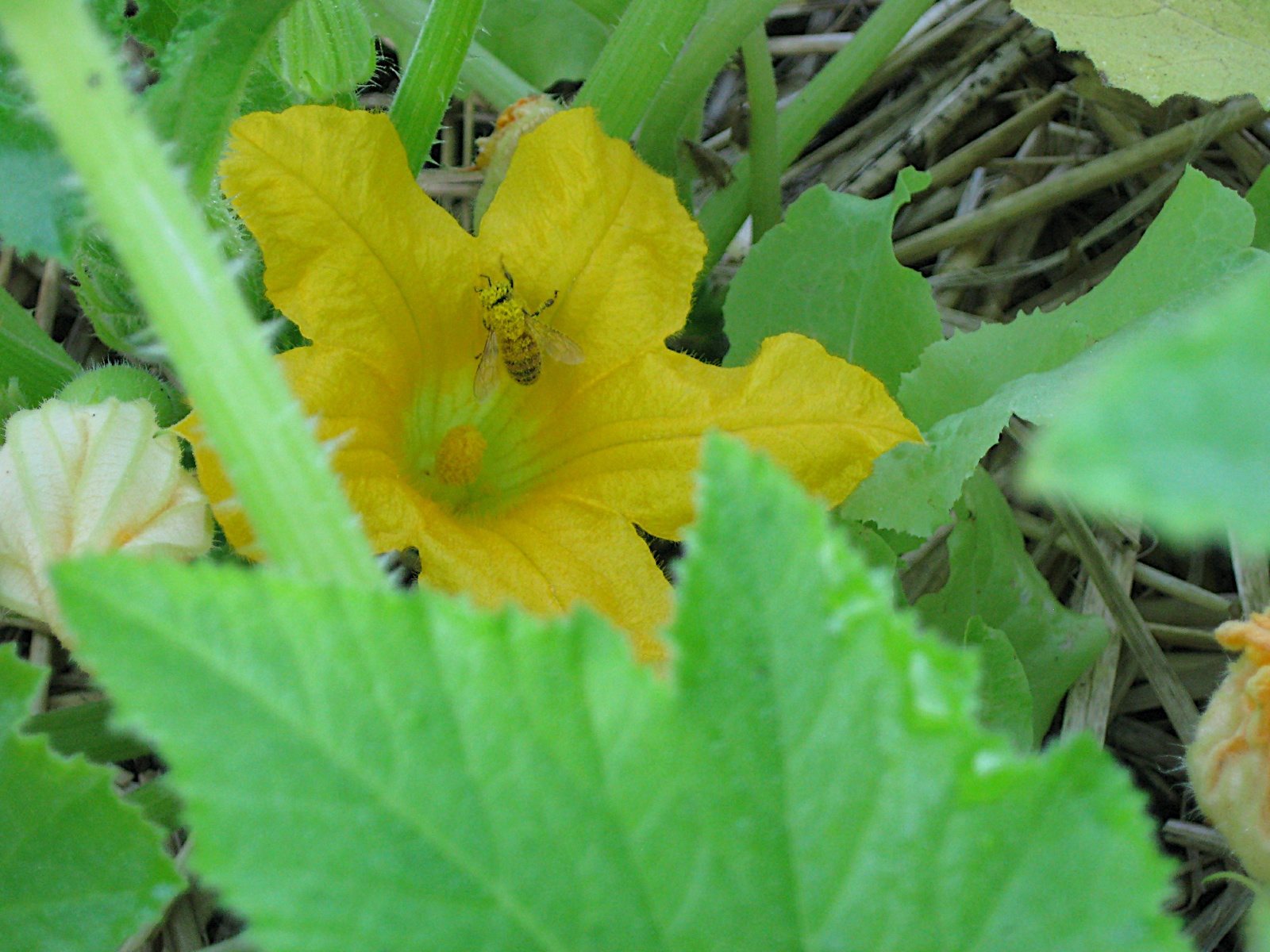
I love it when I catch a pollen-covered bee in one of my flowers. They always look like they're in heaven. In this case, it's one of my many squash flowers. They're blooming like crazy right now.
The irises around the pond bloomed a couple of months ago, but this pickerel weed is just starting to bloom. It has multiple tiny flowers on this plant, and it will bloom continuously for the whole summer. I want to make a few changes to the back yard, which would mean this pond would go, but I would still have room for marginals, like this plant.
This is one that I used to see on occasion, but now I have one in my yard - Stokes' Aster. It's beautiful and it's native to the southeastern United States, which even better!
First cactus bloom of the year. After they are pollinated, prickly pear cactuses will produce fruit that turns a deep red in the winter. It actually tastes pretty good, if there weren't so many seeds in it.
There are recipes for making jams and sauces and even daiquiri mix with it. There are to many seeds in these fruit and it can be a little hard to handle because the juice stains very badly.
About the only thing I know about this plant is that it's called hidden ginger. It produces these blooms on a short stem near the ground, while other leafy stems grow taller. The main flower is pink, and there are smaller yellow blooms below it.
I've been trying for weeks to get a good picture of my hydrangea - thi is probably the best that it will get for now. This is in the shade garden, and it didn't do well last year. A few years ago, I moved it from the back yard (where it was blue) to the front yard (where it is pink). Very interesting.
I just saw something growing out of the top of this Golden Barrel cactus the other day. I assumed that it might bloom eventually, but not so soon! Everything was status quo this morning, but when I left home in the evening it was blooming, and I had no idea it would happen so fast.
Speaking of the pond, this loom popped up recently. It's a water hyacinth and it's an invasive species, if it ever escaped to another body of water. But here in my pond it is contained. There are too many in here right now that you can't even see the water. They need to be thinned.
Friends dropped off a butterfly bush at my house recently. I wasn't sure where to plant it, so it's been sitting in the driveway. In the meantime, it put out its first bloom. Thanks, guys!
Every day something else blooms, but this is going to have to do it for this month. I'll get to work on next month's post as soon as this posts. Enjoy!
27 March 2011
Spring Has Sprung
I was walking around the yard the other day and was surprised at how many things had started growing again. We've had a lot of consistently warm weather this spring - I was expecting it to get cold again or one last freeze, but it looks like it's here to stay.
We had our second bad winter in a row, and it looked like it killed a lot of things - but that doesn't always seem to be the case now that it's warmed up. The most obvious mistake I made when posting obituaries for my plants was including the Queen's Tears bromeliad. As awful as it looks, I noticed the other day that it starting to bloom. This plant has always had odd behavior - the last couple of years it has bloomed very late in the year, so the fact that it's blooming now (which I think is the right time) is odd too. I remember thinking that my bromeliads died last year too, but I was wrong again.
Whenever there are free plants posted on craigslist, if it's something I might want, I do my best to get it, even if I don't know what my plans are for it yet. Last fall someone was giving away knockout roses. I spent part of my Friday evening fighting traffic, digging them up from their yard and getting them home. I kept them in pots over the winter and kept them sheltered some. I was a little concerned they might not make it through the winter, but they did and they're starting to bloom. Now we have to decide where we're going to put them in the yard.
Since my bog experiment failed in the fall, I've had my carnivorous plants in pots, sitting in a container of water. The pitcher plants look bad, but I thought they would be ok. I also got some Venus flytraps and sundews in a strange internet trade - I repotted those and put them in a little water and when winter came, I put them in a sheltered place. The flytraps stayed green through the cold, but the sundews appear to have died. I got a close look at them the other day and the flytraps are flourishing - and the sundews appear to be making a comeback. That's a good thing to know. I plan to create a permanent bog garden, hopefully by the end of the summer, and I'll add these plants to it.
![]() | |
| Queen's Tears Bromeliad |
| Knockout Rose |
Since my bog experiment failed in the fall, I've had my carnivorous plants in pots, sitting in a container of water. The pitcher plants look bad, but I thought they would be ok. I also got some Venus flytraps and sundews in a strange internet trade - I repotted those and put them in a little water and when winter came, I put them in a sheltered place. The flytraps stayed green through the cold, but the sundews appear to have died. I got a close look at them the other day and the flytraps are flourishing - and the sundews appear to be making a comeback. That's a good thing to know. I plan to create a permanent bog garden, hopefully by the end of the summer, and I'll add these plants to it.
19 August 2009
Carnivorous Plants
There are a number of things that can go wrong after purchasing a death cube. The plant comes in a very humid environment, so you have to acclimate it to normal humidity. Some people crack the top a little more each day until they feel safe removing it from the container. Another thing that it has to adjust to is light. It starts out in a low light environment in Lowe's, so don't immediately put in all day full sun. It has to adjust to that as well. I lost a cobra plant to too much sun a while back.
Once I felt knowledge
I strive to have a low-maintenance garden. I was looking for a solution to making pitcher plants low maintenance? I figured that shouldn't be too hard. They are native to our area and winter hardy. I read about planting pitchers in a container of sphagnum peat moss that had a few holes in it. Then put that in a container of water. All you have to do is make sure the second one always has water. I thought I had the solution. I took a shallow barrel liner, drilled a number of small holes in the bottom, laid in a piece of landscape fabric and filled it with sphagnum peat moss. Then I planted the pitcher plants. I took that container and sunk it in the pea gravel bog, where it would get a constant supply of water. They even did well dried out some when the bog was in shambles. They have nothing but thrive since.
Right now I have a couple of different pitcher plants - two prostrate ones and two upright ones. I think the prostrate ones are Sarracenia purpurea and the upright ones are...(this is where I was going to put the latin name, but there are so many similar pitchers that I don't know which is which.) I like the S. purpurea, but they take up a lot of room. I think I'd rather have more upright pitchers. I do have something that not a pitcher plant in there - a butterwort - I got it on clearance at Lowe's for 48 cents! I bought two of them, but one died before I could get it in the bog - death cube lives up to its reputation again! I like to think I saved the other one from certain demise. I wasn't sure how it would do in the bog once it acclimated to it, but it seems to be thriving. My only concern is how winter hardy it is. I tried researching it, but there are so many different varieties that I couldn't get information on the specific one I have. Like everything else, we'll just have to wait and see.
Subscribe to:
Posts (Atom)