Showing posts with label squash. Show all posts

15 June 2013

Garden Bloggers Bloom Day

I started doing a "Garden Bloggers' Bloom Day" post every month last spring, but after the summer and fall, I ran out of blooms to post photos of.  This may happen again this year, but, even if it is only vegetables, I hope to be able to post pics for the whole year - actually I just thought about this, and a lot of winter
vegetables are leafy greens, so maybe I won't be able to.  I'll cross that bridge when I come to it - here are the past months blooms.

I've had trouble with this lantana for the last few years.  It might need more water or more shade.  It's in what I used to refer to as the "desert garden", which gets full sun and drains pretty quickly.  It's doing better this spring, probably due to the fact that we have had so much rain.

You don't always think about certain plants blooming, especially when there are more interesting aspects.  Some carnivorous plant enthusiasts recommend cutting off the stem before it flowers, so it doesn't take energy away from producing more and larger traps, but I don't agree.  These are beautiful, right?

Every year these old garden roses bloom very close
to Mother's Day, early May.  We had a cold spring that just would not warm up.  It finally did and everything started blooming - late - including these roses.

I think I like the blooms of plants that you don't expect to bloom.  Some are just unusual, like these elephant ears.  They got huge last year, and they have recovered well after a mild winter.  I would like to transplant them to a more visible area - right now they are behind the chicken coop - but they are growing through some giant roots, and any attempt to  dig them up would mean their destruction.

This is one of my least favorite plants.  There are probably better varieties of Nandina that have a nicer form, or are sterile, but this one is a pain.  Amongst the switch cane that I was trying to kill by smothering it, was a number of these volunteer plants.  Birds eat the seeds and then sit in a tree and drop them, from one end or the other, and they sprout.  With the help of carpet and chickens I was able to eradicate the bamboo/switch cane, but the nandina would not die, and the chickens won't eat it.

First daylily of the year.  I got this at a plant swap last year, so I didn't know what it would look like until it bloomed.  Apparently its name is "Grape Magic".  I had all my daylilies labeled until recently when I transplanted them to another bed.  So I'm excited to see which is which when they bloom this year.

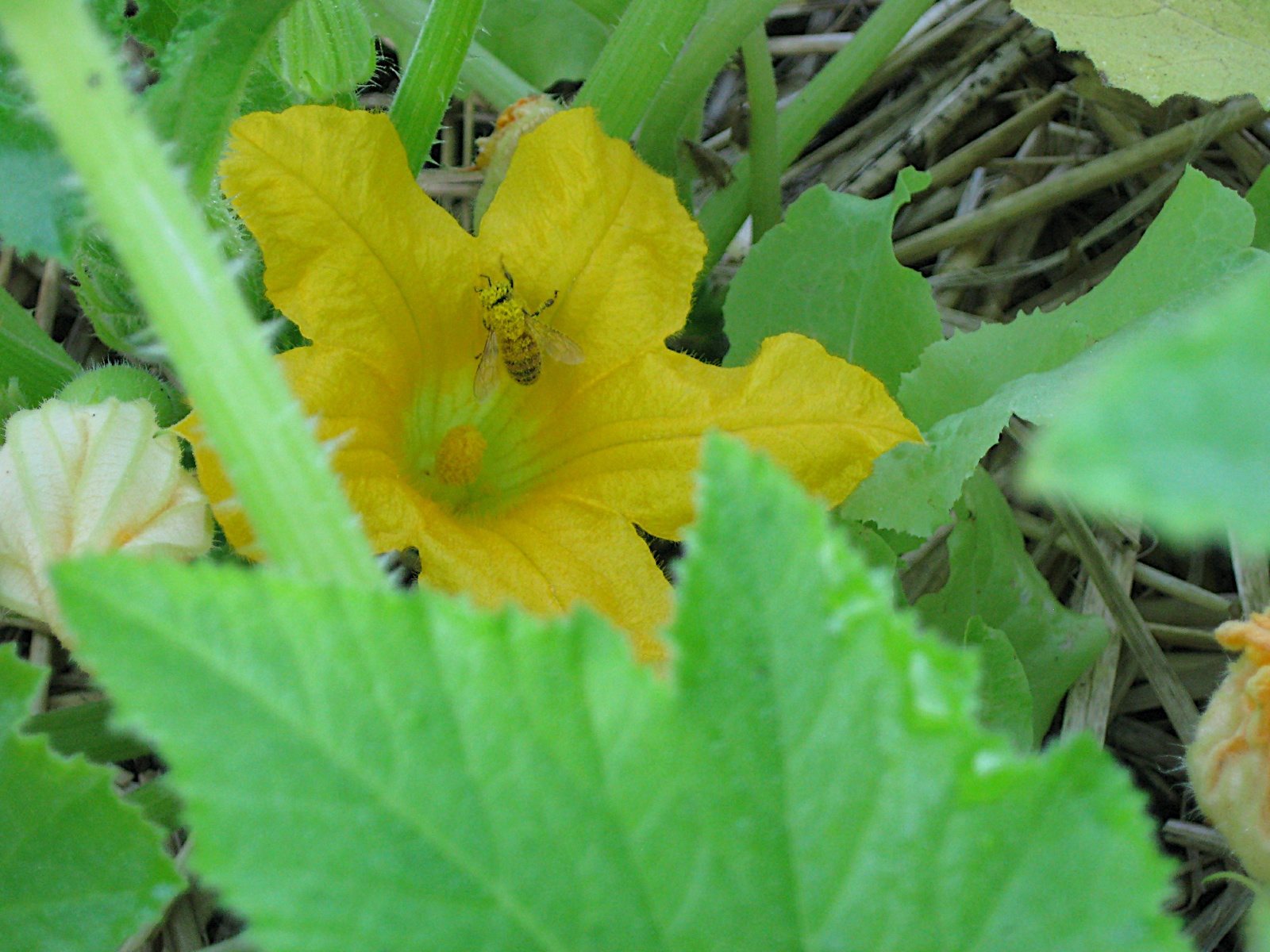
I love it when I catch a pollen-covered bee in one of my flowers.  They always look like they're in heaven.  In this case, it's one of my many squash flowers.  They're blooming like crazy right now.

This is some Rudbeckia, I think, that I grew from seed last year.  I had a number of these plants, as well as Echinacea, and I didn't know which was which until they all started blooming this year.  I also kept getting bees in the pictures of a lot of the flowers, as you can see.  No problem with pollinators in my yard!

The irises around the pond bloomed a couple of months ago, but this pickerel weed is just starting to bloom.  It has multiple tiny flowers on this plant, and it will bloom continuously for the whole summer.  I want to make a few changes to the back yard, which would mean this pond would go, but I would still have room for marginals, like this plant.

This is one that I used to see on occasion, but now I have one in my yard - Stokes' Aster.  It's beautiful and it's native to the southeastern United States, which even better!

First cactus bloom of the year.  After they are pollinated, prickly pear cactuses will produce fruit that turns a deep red in the winter.  It actually tastes pretty good, if there weren't so many seeds in it.

There are recipes for making jams and sauces and even daiquiri mix with it.  There are to many seeds in these fruit and it can be a little hard to handle because the juice stains very badly.

About the only thing I know about this plant is that it's called hidden ginger.  It produces these blooms on a short stem near the ground, while other leafy stems grow taller.  The main flower is pink, and there are smaller yellow blooms below it.

I've been trying for weeks to get a good picture of my hydrangea - thi is probably the best that it will get for now.  This is in the shade garden, and it didn't do well last year.  A few years ago, I moved it from the back yard (where it was blue) to the front yard (where it is pink).  Very interesting.

I just saw something growing out of the top of this Golden Barrel cactus the other day.  I assumed that it might bloom eventually, but not so soon!  Everything was status quo this morning, but when I left home in the evening it was blooming, and I had no idea it would happen so fast.

Speaking of the pond, this loom popped up recently.  It's a water hyacinth and it's an invasive species, if it ever escaped to another body of water.  But here in my pond it is contained.  There are too many in here right now that you can't even see the water.  They need to be thinned.

Friends dropped off a butterfly bush at my house recently.  I wasn't sure where to plant it, so it's been sitting in the driveway.  In the meantime, it put out its first bloom.  Thanks, guys!

Every day something else blooms, but this is going to have to do it for this month.  I'll get to work on next month's post as soon as this posts.  Enjoy!

03 September 2012

Fall Gardening

The weather right now isn't very convincing, but it is time for fall gardening - maybe even late.  Last week when I added the gardening calendar to the site, I realized that I was a little behind.  Still, I decided to plant everything I could.  There's still time for cool-season crops like broccoli, lettuce and radishes, but time is running out (or has run out) on late summer crops like beans and squash.  That's what I've been thinking about this weekend.

There's a feed store near where I've been attending a gardening class the past several Tuesdays - one time I bought chicken feed, another time hay.  I noticed that they had a large variety of seeds for sale.  Once I made the gardening calendar, I made plans to buy seeds for everything that I need to plant in the coming weeks, as well as what I should have planted already.  I bought a leaf lettuce, two types of radishes, two types of summer squash and two types of winter squash, and broccoli plants to transplant in the garden.
I put the broccoli in the other day and planted a few winter squash seeds, but saved the rest of my work until now.  I was looking up some of the seeds online last night to see if there was anything special I needed to know.  Mostly, I was curious about how long it would take them to reach maturity and whether the squash was a bush- or vine-type.  The "days to maturity" is important to know for the warm-seasons vegetables like beans and squash, because we have only a limited number of days until a frost.  Also, I planned to grow the squash on a trellis, so I wanted to know which ones would vine and which ones would bush.

The butternut squash I bought is 90-100 days, which means it's too late in the year to plant it.  Our first frost date is about November 20th, which gives me less than 90 days.  The other winter squash I bought is an acorn squash.  Its listed around 70-80 days, but it's a bush-type, which is not what I want for trellising.

I think I'm going to skip the squash this late in the season, go with the cool season crops - lettuce, radish and broccoli - and plant some beans, which, if they don't give me any pods, I can still turn them under, giving me a little nitrogen for my next planting.

03 April 2011

Summer Vegetable Garden

Flowering Purple Majesty Potatoes
Our vegetable garden is coming along nicely these days.  I'm close to adding another bed, and adding a composting pile - also, I just added trellises that I really like.  Since my seed starting didn't go as planned this year, I needed to go out and buy a few plants.

I went to Lowe's this morning with the intention of buying squash, pepper and tomato plants and watermelon seeds, and came home with:

Crookneck Squash
Better Boy Tomatoes
Red Bell Peppers
Sweet Banana Peppers
Crimson Sweet Watermelons

To me, the cost can really add up when buying vegetable plants.  I try to find the best deal by looking at the price and the number of seedlings in the pack.  A number of 4-packs, for example, will have more than one per section.  It might not be the best idea to divide these plants, but it's worth trying.  There were nine tomato plants in the 4-pack that I bought this morning.  I divided the tomato plants and planted the three largest ones in the garden, stripping off lower branches and planting them deeper, to encourage a better root structure.  I also potted the other six and I'll either leave them in pots or plant them in the garden at a later date.  I put the plants next to one of my new trellises, hoping to use it to support the tomatoes as they grow.

I got 5 banana peppers, but I had a hard time finding bell peppers.  I looked for a long time and only found green ones - I finally found individual pots of red bell peppers instead of multi-packs.  I bought two pots of those which got me 4 plants.  I had planned to put the squash in the same bed, but after planting the peppers, there wasn't enough room - knowing how big the squash plants will get.  I had plans to devote a whole field to corn - when I say "field", I really mean a 4 x 8 bed  - but I needed more room to plant the squash.  I almost have a "3 Sisters" garden going on there.

Before I went to Lowe's, I planned to buy watermelon seeds - they were cheap and I have all summer, right?  So, when I was looking at all of the vegetable plants, I ran across watermelons.  There were a couple of different varieties - one would grow 20 pound fruit or the other, Crimson Sweet, would grow to about 10 pounds.  I chose the Crimson Sweet variety for a couple of reasons - I grew it last year and it is a recommended variety of the Clemson Extension, and I plan to trellis these plants.  I don't know how well this will work, but I thought I might have better luck with smaller fruit than trying to support 20 pound watermelons on a trellis.

Wish me luck and hopefully this season will be great!

27 February 2011

Trellising

I had plans to write about growing plants on trellises last year, but I never got around to it.  We have some latticework hiding our garden storage area and I was thinking about growing vining vegetables on it this spring.  Those plans changed when we decided to expand the kitchen into the garden storage.  We haven't done that yet, but I'm giving up on using it as a trellis.  I've decided to add trellises to each of my  raised beds to increase the varieties of vegetables that I can grow.

During the past several summers, I had constructed some sort of trellis for supporting pole beans, but it was always temporary or very last minute - it never lasted longer than the season and I would do something different the next year.  This year I'd like to do something I can use every year, but also, so that I can put it away in the winter.  There's a section in the "Square Foot Gardening" book about building garden structures, but I think I donated my copy during a recent decluttering.

While I'm curious about growing interesting vegetables, I'm also practical.  Recently I started growing only vegetables that I knew we would eat and growing as much as possible.  Some of the plants I plan to trellis are either curiosities or untested as to whether we will eat them.  I saw a photo accompanying an article on trellising and they grew pumpkins - they used stockings to support the fruits as they grew larger.  I want to do that!

So, my trellising - I'm definitely going to plant pole beans and cukes in the spring.  As it get later into the summer, I'll be planting more experimental plants.  In my search for vining plants, I've decided to try winter squash.  It's just another variety of squash that takes longer to mature, but will keep for a lot longer - good for use as a winter storage vegetable.

I got a dried apple gourd from a recent plant swap and at some point I cracked it open and collected the seeds.  I planted some last year, but they never made it out of the seed flats.  This year I think I'll plant some on a trellis and hopefully get some apple gourds of my own.

14 May 2010

Flowers

I haven't done a whole lot in the yard lately - mainly, I've been noticing flowers. Watching them go from buds to flowers to seed pods has left me wanting to know more. I know the basics of pollination, even if I don't remember what each part of the flower is called. (I started studying today) Last fall I did a little seed collecting and this spring I've been planting a lot of seeds, but I've really become interested in the last couple of weeks. I also tried to cross pollinate a couple of my daylilies last year, but I didn't get any seeds from it.

First it was the irises. I watched each one bloom and die, but I think only the water irises have seed pods - maybe the higher pollination rate is due to the water attracting more insects. Last year I was thinking the same thing - I'll collect the seeds and grow some more - but I always have too many of these things - so I don't know what I'll do with the seeds.

I brought home a few lilies from a now-wild area of the neighborhood and they have since formed seed pods. I've collected seeds from most of them, but I don't know when I should plant them. After some research, there are different techniques, depending upon which type and I don't know what these were. I'll spend some time this summer researching and I'll let you know what I find out.

My pitcher plants have been blooming for the last several weeks and I've been really curious about their structure. I could see into them until a few of the "petals" fell off. It appears that they have produced seeds, but most of them have fallen out of the flower. I'm not sure if I want to bother with germinating them - I've heard it takes months - and the plants you can buy at Lowes - I think those are two years old - too much of a commitment for me.

Before I had planted all of my squash, they started blooming - the same with my cucumbers. I didn't have anywhere to put them in the ground, so I just transplanted them into larger pots. As they continued to bloom, I thought I would try to take advantage of this and hand pollinate the flowers. As I started looking at the flowers, they turned out to be all male. This got me wondering about squash flowers, so I read about them in the master gardener's training manual - apparently most of the early flowers on squash are male. So I'll be biding my time until a female flower shows up.

I know you're supposed to be able to grow potatoes from seed as well as from a potato, so when my potatoes began flowering, I held out hope that maybe there might be seed pods when they were done, but no such luck. That's fine - they're very easy to grow from a potato eye. Same goes for water lilies. I've always wondered about getting seed pods out of them. A big problem is that there are so few blooming at the same time in most situations - except for the wild, white cowlilies that you see in ponds and ditches everywhere.

The last plant I want to mention is probably my favorite at the moment, at least as far as pollinating goes - it's the yucca. There's one on my route that I've been watching flower for the past few weeks, knowing any day the landscapers will chop it off, but it hasn't happened yet. I've been doing some research and I think I've figured out how to pollinate it. I'll let you know how it goes.

Second Summer Planting

In the near future I'm going to have some empty garden beds to fill and I don't have a clue what I want to plant. I know I can plant more of the same - corn, beans, tomatoes, etc. I'll probably do that - I've got some more corn to plant and various beans - pole beans, bush beans and cow peas (black-eyed peas). If I'm not mistaken, I think you let cow pea pods dry on the plant before picking them. Then you can store them dry until you cook Hoppin' John and collard greens on New Year's Day. If I do plant those, I really ought to plant collard greens this fall too.

I'll probably buy a couple of plants from Lowes. I'm growing peppers, but they're a little stunted and the second group of tomato seedlings didn't fair so well. So maybe I'll buy two pepper plants and a tomato plant or two. I'm also thinking I should plant zucchini - it's not my favorite, but we would eat it - in a casserole or sauteed with other vegetables.

I haven't been successful with everything I've tried growing this year, but it's a huge improvement over last year. I think because I've been landscaping and building raised beds, I didn't start some of my seeds early enough or not at all. So I feel like I'm playing catch-up a little, but overall, I think I'm doing pretty well this year.

25 April 2010

Front Yard Garden

I was glad to be off this past Wednesday, because I still had plants I wanted to get in the ground - and it took me longer than expected. I was expanding the vegetable garden into the beds in the front yard and had to move the plants that were there. After taking Ella to school, I went by the recycling center to get some compost, but they were out. I thought this was a little strange, but it was Earth Week and there is a sale on compost during April, according to Ken Burger's column in today's paper. It was also raining sporadically, so with two strikes against working in the yard, I took the morning off.

Once I made it outside, I started clearing the bed of plants - mostly lilies, but also a citrus that survived the winter that I had to pot up. After digging up the six or seven clumps of lilies - crinum asiaticum(I think) - I decided that, since I didn't know where they were going yet, until I do, I should pot them up for now. I was thinking about doing a mass planting somewhere, but don't know just yet. And while I'm digging, I figure I should go ahead and divide the clumps - they're quite large. I spent the rest of the morning and through lunchtime dividing and potting the lilies, ending up with 35 of them, some having multiple bulblets too small to divide.

I had an afternoon of non-gardening activities to do, so it was early evening before I got back to work. I worked some compost from a near-empty raised bed into the front garden and laid out three hills for squash, a place for watermelon to roam and room for supports for cucumbers and gourds. I planted nine Early Prolific Straightneck squash in the three hills and four watermelon vines, but I still need to get supports for the cukes and some for beans as well.

We had some much needed rain this weekend and the corn I planted a week ago is coming up, So everything is going well.

24 March 2010

Garden Update

I have a lot of gardening and landscaping plans for the spring and summer - I just haven't gotten to them yet. I realized as my seeds* were sprouting this week that I was using my only completely free raised bed as a cold frame and I needed to do something about that.

*Both varieties of squash are sprouting, Razzleberry tomatoes, a few cucumbers and maybe a pepper, coneflower and agapanthus. I've also got another tomato, another pepper, watermelon, beans and corn to get started as well.

I can't decide what to do with my pole beans. I was going to put up a trellis made from conduit and twine, but now I'm wondering if it would be easier to do a tripod/tepee in the flower beds where I plan to grow watermelon, squash, cucumbers, pumpkins. I have so many questions about that - I was going to grow cucumbers up a trellis, but they're "salad bush hybrid" - does that mean they will be less of a vine? And am I planting too much of the same family together - squash, cucumber, pumpkins, watermelon?

Anyway, I got some more compost this morning. I opted to get $2 bags from the Romney Street location rather than loading my own at the landfill. I don't need as much right now - just enough to improve the soil in the landscaped beds so I can plant veggies out there. I'm rethinking the design of the bed, now that I've included part of the front yard in my vegetable gardening plan. I've got citrus that I want to put back into a pot, daylilies that I'll eventually move somewhere else - the same goes for the lilies, irises and phlox. I've got garlic that I'll harvest this summer. After all that, maybe I'll be able to design a nice planting that lets me incorporate long term landscaping with vegetables.

Other things growing - The potatoes I planted just over three weeks ago have broken the surface and the spinach is getting to be large enough to start harvesting. Daylilies have sprouted. The water hyacinths in the pond - I had given up on them, but hadn't tossed in the compost pile - they've got new growth on them.

My list of things I want to do is growing as well. The area in the front yard where the garden is, will become a continuation of the side flower bed and curve around in front of the house. I have to edge and smother the grass and mulch. Then I have to decide what to plant and put a path through it to the side gate. I'm planning to use pieces of broken concrete to make something that looks like a stone path. I've started collecting it recently.

I'm planning to take another shot at a shade garden, my first attempt not being the best location, as it turns out. I hope under our oak tree will be good enough. It gets a little morning sun and a little more evening sun - I hope it won't be a problem. I have a 50% off coupon for a garden catalog that I was going to use to buy all the plants for the shade garden when I was ready, but the coupon expires in April and I just don't think I'll be working on it at that point - and with shipping, who knows how much I'll really save.

According to my plan, I need to build two more raised beds (maybe three). I also need to lay out beds in the back yard. There's a strip of grass about a foot wide along the driveway that I want to rip up and plant a ground cover...

More rain barrels, chickens, rain garden/bioswale. The list goes on...

07 March 2010

Spring Seed Starting

I got some of my vegetable seeds started today. Here's list:

Tomato - Razzleberry Hybrid
I got this free with my order from Park Seed.

Squash - Early Prolific Straightneck
Hopefully these will be ok. I've had these for two years, apparently.

Squash - Dixie Hybrid
Same goes for this variety, too. I got these last year and never planted them.

Cucumber - Salad Bush Hybrid
They looked like nice, small cucumbers, and are recommended for our area. I'mn planning to grow on a trellis.

Pepper - Sweet Spot X3 Hybrid
These look like sweet banana peppers that Robin wants.

Pumpkin - Autumn Gold Hybrid
I got three varieties of pumpkins to play with - small, medium and large. The first two will probably make good jack-o-lanterns, and I'm curious about the large one. They're supposed to be hundreds of pounds. I heard my brother-in-law tried these a few years ago - I thought I ought to try them out.

I'm also starting some non-vegetable seeds. If these get to a decent size in a month, I may take some to the plant swap - probably not likely.

Confederate Rose (hibiscus mutabilis)
I got a seed pod off of one around the corner from our house.

Agapanthus
I read an article about these in the paper and I started seeing them around. When one set seed, I collected some. PJ Gartin said she collected seeds the same time I did, "though I suspect that what I'll get (if anything) might not exactly like the parent plant. However, that's just the risk seed collectors take." She also told me that it may take 30-90 days for germination.

Devil's Trumpet
This plant had a couple of huge seed heads, almost the size of a golf ball. I harvested the seed and we'll see how it goes.

Echinacea - "Bravado"
Robin really wants coneflowers, so I bought a number of kinds from Park Seed.

I'm still waiting on several things from Park Seed:
Tomato - Better Boy Hybrid
Coneflower Collection
Pumpkin - Howden, Big Moon

11 January 2010

2010 Vegetable Garden Planning

It seems that I am doing more vegetable gardening than anything else these days. I'd like to write about a variety of topics, but this is monopolizing my gardening time lately. It's still at least three weeks before I plant potatoes and onions and maybe more lettuce and spinach, and I'm already planning the vegetables for the summer. It seemed a little early when I was looking through my Park Seed catalog Sunday night, but as I thought about it, some of the vegetables will be transplanted to the garden in late March, after having been started from seed six weeks earlier - around the second week of February. After I realized that, I felt like I was almost late. So, these are my choices from the Park Seed catalog - most of these varieties are recommended for our area by the Clemson Extension and can be found in my vegetable garden chart.

Pole Beans - Kentucky Wonder, Blue Lake, Kentucky Blue
Kentucky Blue looks likes the best, but I've grown the other two, so I might get all three. I'll be able to compare the three and see which ones I want to grow in the future.

Sweet Corn - Early Sunglow, Silver Queen
These are regular sweet varieties, rather than a super sweet or sugar-enhanced hybrid. The Early Sunglow can be planted earlier than normal, so we'll get corn through the whole growing season.

Cucumber - Sweet Slice, Diva, Sweet Success(seedless), Salad Bush
I know we won't eat all these cucumbers, but I thought I might grow one. The Salad Bush variety looks like the one for us. The catalog calls it "a space-saving slicing cuke".

Watermelon - Sweet Beauty Hybrid
I know we might only eat a slice or two of watermelon, It's always good to have one to eat in the summer, and if I have more, I'll give them to neighbors or take one to a fourth of July party.

Peanuts - Gregory
I've never grown peanuts before, but I thought I would give them a try. I have to figure out how many plants I need to get about two pounds of peanuts. I boiled some peanuts a couple of summers ago in the crock pot and they turned out pretty well.

Pumpkin - Autumn Gold, Howden, Big Moon
I don't know if I'll grow all of these varieties. They are very different, so I thought I might try them all. Autumn Gold pumpkins are 7-10 pounds. Howdens will be 20-30 pounds. According to the catalog, Big Moon may produce 150 pound fruit. I think my brother-in-law grew some of these huge pumpkins a couple of years ago and I'm just a little curious.

Squash - Early Summer Crookneck, Enterprise (straightneck)
To the best of my knowledge these are bush type squash and I'd really like a vining type. Squash take up a lot of space and I'd like to grow these on a trellis of some sort if I can. Several years ago, I bought a squash plant from Lowes and it was a vining type. Ever since, I've ended up with bush type, and I'd rather not have that. If I can't find what I'm looking for, I think one of my neighbors grows it and probably has some seeds I can have.

Tomatoes
I'm still looking at tomatoes - I haven't decided which variety to grow yet. Everything I read about them, talks about how many diseases they can have, so I don't think I'm planting them in the garden ever again. I'm planning to use five-gallon buckets to grow them in from now on. I can put them anywhere and it'll leave room in the garden for other veggies.

Peppers
Same goes for the peppers. There's even more variety of peppers than tomatoes, or it seems like. I'm planning to get a few varieties of bell and sweet peppers for Robin.

Sunflowers
I'll probably get a mix of sunflowers and stagger plantings through the year, so we'll have them for a long time.

Coneflowers
I'm planning to get the four different varieties that Park Seed has.

Strawberries
I've got to learn a little more about strawberries before I buy any. They're sold as plants, so I have some time before I need to order them.